
In the context of innovation and entrepreneurship, the lengthy document and colour-coded spreadsheet is total nonsense. Innovation and entrepreneurship are a search challenge, not an implementation challenge.
Innovation and entrepreneurship are a search challenge, not an execution challenge
Traditionally, the business plan is a 20+ page document with a spreadsheet attached. The document outlines your idea and how you intend to implement it. The spreadsheet outlines your financial projections over several years.
In the context of innovation and entrepreneurship, the lengthy document and colour-coded spreadsheet is total nonsense. Innovation and entrepreneurship are a search challenge, not an implementation challenge.
When uncertainty is high, you’re better off admitting that you don’t know if your idea is going to work. Your job is to shape, test, and adapt all aspects of your business idea until it’s likely to work at scale. The task isn’t to blindly implement what appears to be a great-looking idea outlined in a business plan. The task is to search for:
-
A value proposition that customers care about
-
A profitable and scalable business model
The problem with traditional business plans
There are three reasons why traditional business plans are dangerous in the context of innovation and entrepreneurship:
-
We make an idea look awesome and describe its implementation as if we know it is going to work
-
We invest in fantasy numbers as if it were possible to project them over several years for an unproven idea.
-
We don’t accept that in the uncertain context of innovation and entrepreneurship, unproven ideas are likely to change more or less radically until they (might) work.
The consequence of the above is that we focus on what might look like a “good idea” and then invest in its execution. Of course we now know that the initial idea often changes more or less radically. Youtube started as a dating site. Nespresso as a business-to-business concept. Nespresso almost got killed by their owner, Nestlé, because they didn’t make the business plan. Both had to radically change in order to succeed. Both are now multi-billion dollar businesses that have nothing to do with the original business plan. That’s just two examples of many.
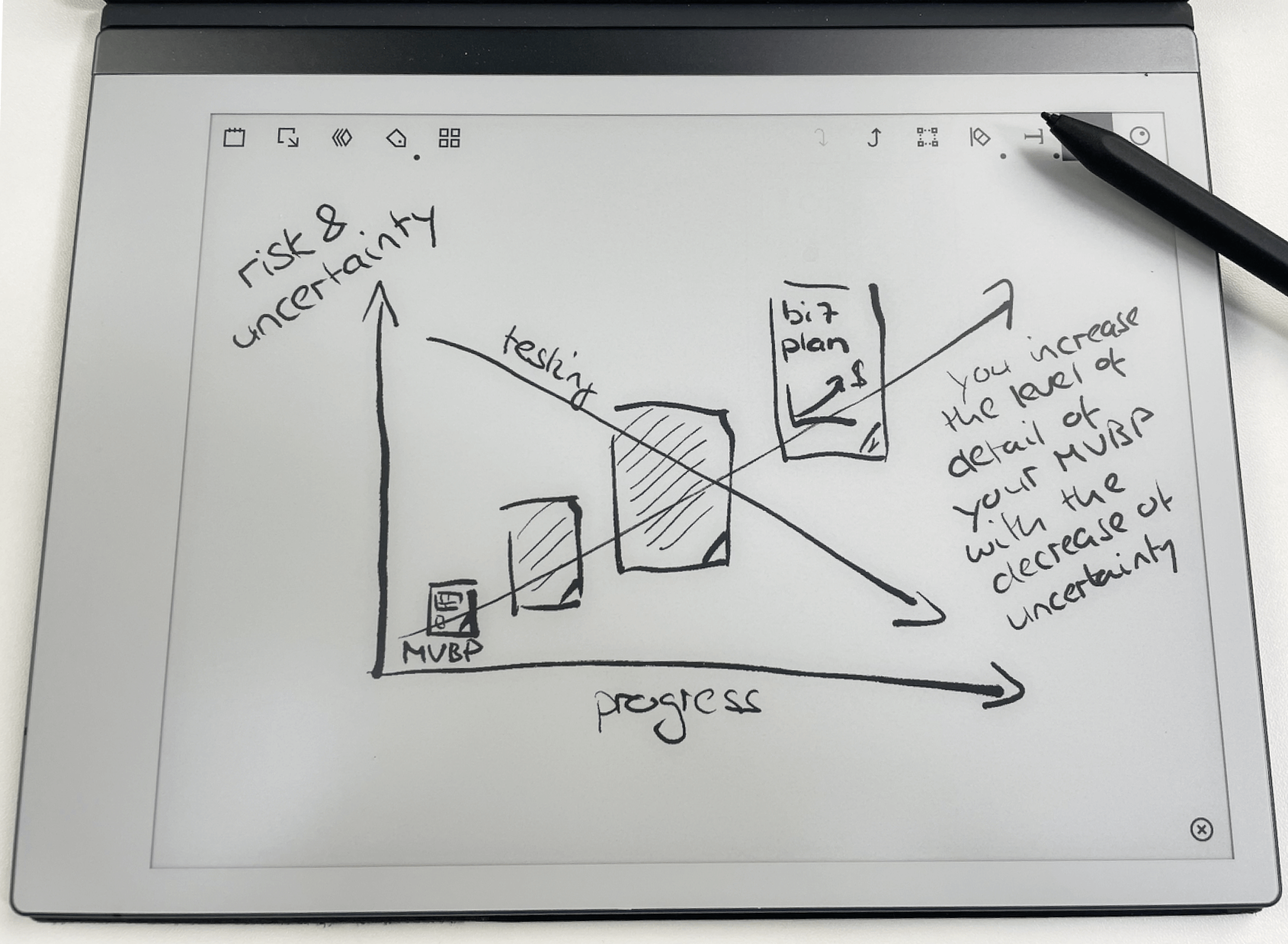
From static business plan to Minimum Viable Business Plan (MVBP)
Here’s a better approach. Start with a Minimum Viable Business Plan that you continue to iterate and refine based on the evidence you gather in the market. Here’s a sketch of the process that fully builds on what Strategyzer and Steve Blank already preach:
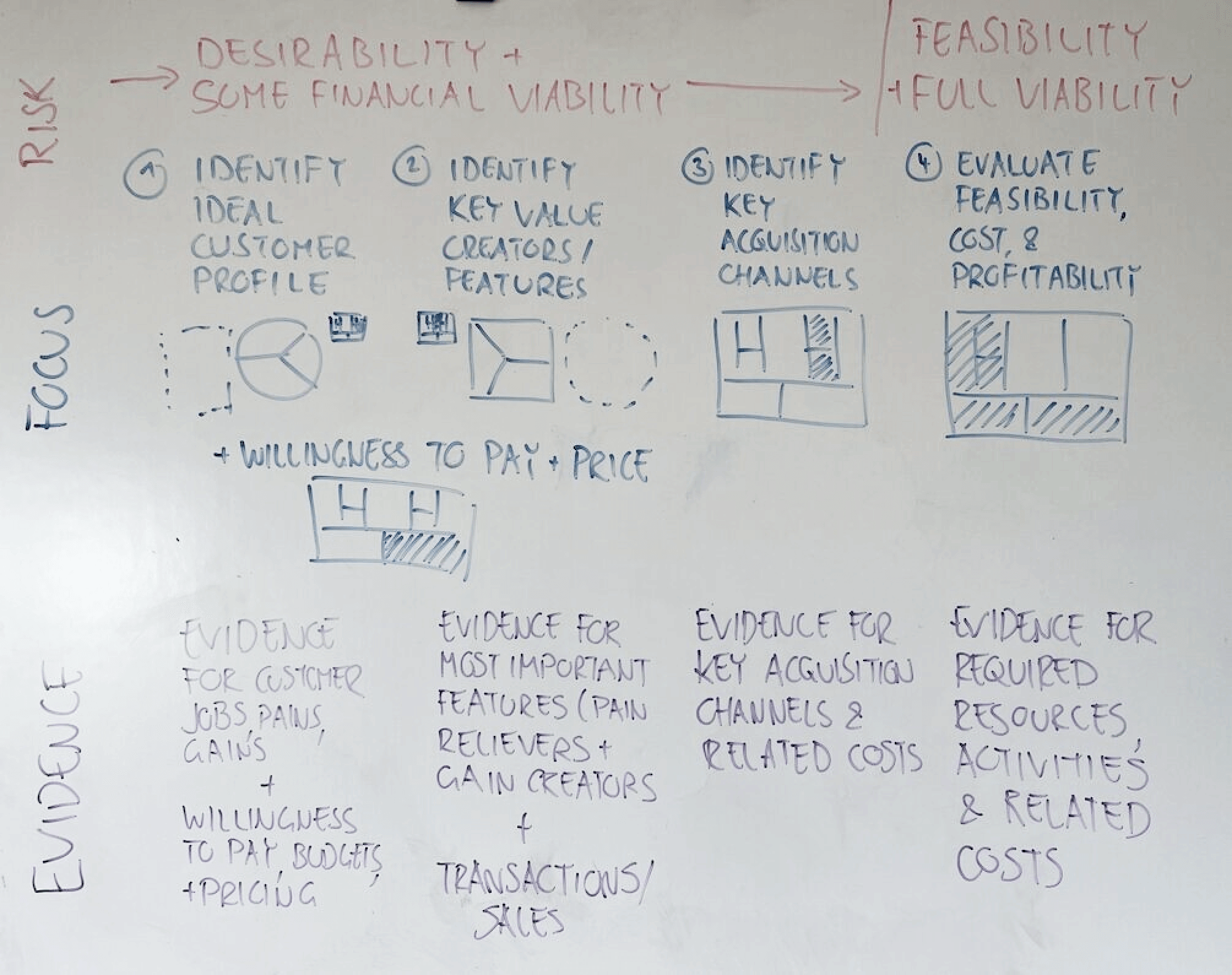
1. Rough out a Minimum Viable Business Plan (MVBP) in a couple of hours (1 day max):
This includes a Business Model Canvas, Value Proposition Canvases, a back of the napkin calculation or spreadsheet of your revenues, and the key hypotheses you intend to test. You fully admit that everything in this MVBP is likely to change.
2. Test and adapt until customers care about your value proposition(s) and refine your MVBP accordingly:
Your MVBP is no longer pure fantasy since you have evidence for customer jobs, pains, and gains (or “problem”) and your value proposition (or “solution”). You can now proceed to some evidence-based market sizing. Ideally you also have first evidence for willingness to pay at this stage. You’re starting to gather evidence to back up your fantasy spreadsheet.
3. Test and adapt customer acquisition, retention, and pricing and refine your MVPB accordingly:
Your goal here is to support your fantasy spreadsheet with real evidence. Equipped with this evidence you can proceed to a more fine-grained modelling of your revenues and ideally costs and profitability.
4. Turn your MVBP into an execution-oriented business plan:
Equipped with sufficient evidence for all aspects of your business model you can proceed to scaling. This is the point at which a more traditional business plan could make sense.
I realized how important it is to sketch out a full business model and rough numbers at the beginning of the innovation and entrepreneurship journey many years ago. First evidence for this came from Dr. Henning Trill when Strategyzer collaborated with him to build up Bayer’s Catalyst (Innovation) Fund. He explained to me how much he valued our approach of focusing on business from the get-go rather than just focusing on product. The key is to keep it rough rather than getting stuck in analysis paralysis.
The Minimum Viable Business Plan approach is simply a refinement of the documentation of what I already explained in my post on the phases of the innovation/entrepreneurship journey. It does of course require corporate leaders and investors to see the first sketch as pure fantasy. They need to push teams to provide increasing evidence for each phase of the journey.
The One-Page “Living” Business Plan (All You Actually Need)
You do not need 50 pages. You need one page. And that page should change every week as you learn.
The one-page plan template:
1. The problem (one sentence):
“What problem am I solving, and who has it?”
2. The solution (one sentence):
“What am I building to solve it?”
3. The customer (one sentence):
“Who feels this problem most urgently?”
4. The channel (one sentence):
“How will I reach them?”
5. The revenue model (one sentence):
“How will I make money?”
6. The next experiment (one sentence):
“What is the single most important thing I need to learn this week?”
7. The success metric (one sentence):
“What number will tell me I am on the right track?”
That is it. Keep it on one page. Update it every week as you learn.
Example (a meal prep service):
- Problem: Busy parents waste time planning weekly dinners.
- Solution: A text message with 5 dinner recipes and a grocery list every Sunday.
- Customer: Working parents with kids under 10.
- Channel: Facebook parenting groups and Instagram ads.
- Revenue: $15/month subscription.
- Next experiment: Can I get 10 people to pay $15/month with a simple landing page?
- Success metric: 10 paying customers by end of month.
No 50 pages. No five-year forecasts. Just a hypothesis to test.
Step 1: Start with a Problem, Not an Idea
Most people start with an idea. “I want to build an app that does X.” That is backwards.
Start with a problem. “People struggle with Y. That struggle costs them time, money, or sanity.”
How to find problems:
- What do people complain about in online communities?
- What tedious task do you do repeatedly?
- What did you wish existed last week?
- What are people asking for that does not exist?
Test your problem:
Talk to 10 people who might have this problem. Ask: “Tell me about the last time you experienced [problem].” Do not mention your solution. Just listen.
If they describe the problem with emotion and specifics, you have something. If they shrug and say “it is fine,” find another problem.
Step 2: Build a Landing Page (Not a Product)
Before you build anything, build a landing page. One page. A headline. A description. A button to sign up or pre-order.
What your landing page needs:
- A headline that names the problem.
- A sub-headline that promises a solution.
- 3–5 bullet points of benefits (not features).
- A call-to-action button (“Get early access,” “Pre-order now,” “Join the waitlist”).
- An email capture form.
Tools to build it in under 2 hours:
- Carrd (free, simplest).
- Leadpages (paid, more features).
- Unbounce (paid, A/B testing).
- Squarespace (paid, beautiful templates).
What to do next:
Drive traffic to your landing page. $50–$100 of Facebook or Google Ads. Or post in relevant communities. Measure how many people enter their email.
If 5–10% of visitors give you their email, you have demand. If less than 2%, your problem or solution needs work.
Step 3: Sell Before You Build
The ultimate validation is a credit card. Not a compliment. Not an email address. A credit card.
How to sell before you build:
- Add a “Buy Now” button to your landing page.
- Offer a pre-order discount (“Launch price: $49. Regular price: $99”).
- Be honest: “This product does not exist yet. Your pre-order funds the development. Estimated delivery: 90 days.”
- If people buy, you have real validation.
- If no one buys, you have saved yourself months of building something nobody wants.
What if I cannot deliver?
Refund their money. Apologize. Explain what you learned. Most customers will respect your honesty. Some will even encourage you to try again.
Real example: The Pebble smartwatch raised $10 million on Kickstarter before building a single unit. They sold before they built. You can too.
Step 4: Build a Minimum Viable Product (MVP) in Days, Not Months
Your MVP is the smallest possible version of your product that solves the core problem. Nothing more.
What an MVP is NOT:
- A polished, feature-complete product.
- Something that scales to millions of users.
- Something you are proud to show your mother.
What an MVP IS:
- Something that works for one customer in one specific situation.
- Something you can build in 1–4 weeks.
- Something that embarrasses you a little.
Examples of MVPs:
- A concierge MVP: Do the service manually. Send spreadsheets. Make phone calls. Learn what customers actually need.
- A wizard of Oz MVP: Pretend the automation exists. Do the work behind the scenes. Automate only what customers actually use.
- A single-feature MVP: Build one thing. Do it well. Ignore everything else.
Pro tip: If you are not embarrassed by your MVP, you launched too late.
Step 5: Talk to Customers Every Week (No Exceptions)
A business plan assumes you know the answers. Customer conversations reveal the questions you did not know to ask.
Who to talk to:
- People who signed up but did not buy (what stopped them?)
- People who bought (why did they buy? what almost stopped them?)
- People who stopped using your product (why did they leave?)
- People who never heard of you (would they want this?)
What to ask:
- “What was happening in your life right before you decided to try this?”
- “What has been the most frustrating part of using our product?”
- “What would have to change for you to use this more?”
- “What have you told your friends about us?”
How many: 3–5 conversations per week. Every week.
Pro tip: Record every conversation (with permission). Listen back. You will hear things you missed.
Step 6: Adapt Your “Plan” Weekly (The Agile Business Plan)
Your one-page plan is not a contract. It is a hypothesis. Update it every week based on what you learned.
Weekly review questions:
- What did I assume last week that turned out to be wrong?
- What did I learn from customer conversations?
- What should I change about my problem, solution, or customer?
- What is the most important thing to test this week?
- What will I stop doing?
Example weekly update:
- Week 1: “I think busy parents need meal planning help.”
- Week 2 (after 5 interviews): “Busy parents actually need grocery delivery integration. The planning is not the hard part. The shopping is.”
- Week 3: Change solution from “meal planning template” to “one-click grocery delivery.”
- Week 4: Test new landing page. Higher conversion. Proceed.
The plan changed completely in one month. That is not failure. That is learning.
When You Actually Need a Formal Business Plan
There are times when a formal plan is necessary. But those times come after validation, not before.
You need a formal plan when:
- You are raising money from banks or traditional investors (they expect one).
- You are applying for a business loan (the bank requires it).
- You are buying a business (due diligence requires analysis).
- You are partnering with a large company (they want to see your thinking).
You do NOT need a formal plan when:
- You are starting a small business with your own money.
- You are testing an idea.
- You are building an MVP.
- You are trying to get your first 10 customers.
Write the plan after you have customers. Not before.
A Real-World Example: The Baker Who Built a Business Without a Plan
A woman named Elena wanted to start a gluten-free bakery. Everyone told her to write a business plan. She tried. She got stuck.
Instead, she started small.
Week 1: She baked 20 gluten-free muffins. She gave them away at her kid’s school. She put a note: “Text ME if you want more. $3 each.”
Week 2: She got 15 text messages. She baked 50 muffins. She sold out.
Week 3: She created a simple order form using Google Forms. She shared it in a local Facebook group. She got 40 orders.
Week 4: She rented a commercial kitchen for 4 hours per week. She baked 200 muffins. She sold out.
Month 2: She added cookies and bread. She hired a helper.
Month 3: She opened a simple website using Squarespace. Online ordering. Local delivery.
Month 6: She had 500 weekly customers. She quit her job.
Month 12: She wrote a business plan. Not to start. To get a loan for her own storefront.
Elena built a business without a plan. She validated demand. She talked to customers. She adapted weekly. She wrote the plan only when she needed it.
You can do the same.
Frequently Asked Questions (FAQ)
Is a business plan ever useful?
Yes, but later. After you have customers, revenue, and data. Before that, a plan is just fiction.
What if I need funding?
For friends and family or small angel investors, a one-page plan and a prototype are enough. For banks or VC, you will need a formal plan. But get customers first. It is easier to raise money with revenue than with guesses.
How do I know if my idea is good without a plan?
Test it. Build a landing page. Run ads. See if people sign up. Sell before you build. If strangers give you money or email addresses, your idea has potential. If not, change it.
What if I fail because I did not plan enough?
Most businesses fail because they build something nobody wants, not because they lacked a plan. Testing your assumptions is better than planning your assumptions.
Can I use this approach for a physical product?
Yes. Build a prototype (3D print, handmade sample, CAD drawing). Create a landing page. Take pre-orders. Use the pre-order money to fund production.
The Bottom Line
You do not need a 50-page business plan. You never did. That advice was for a different era. An era when markets moved slowly. When you could predict five years out. When customers had fewer choices.
That era is over.
Today, you need speed. You need customer feedback. You need the courage to be wrong quickly and adapt faster.
- Start with a problem, not an idea.
- Build a landing page, not a product.
- Sell before you build (pre-orders, deposits, waitlists).
- Build an MVP that embarrasses you.
- Talk to customers every week.
- Update your one-page plan weekly.
- Write a formal plan only when you need funding.
A business plan is a guess. An experiment is a truth. Run experiments. Learn truths. Build a business.
Your first customer is waiting. They do not care about your plan. They care about their problem.
Go solve it.
Ready to build your business without a business plan? Share this post with a fellow entrepreneur who needs to hear it. And subscribe to our newsletter for more lean startup strategies every Tuesday.