

Vision, hallucination, and customer reality.

Vision sees what could be. Hallucination sees what never was. Reality pays the bills.

You may think you know what customers want; but until you test and gather evidence on their reality, you’ll just be following a hallucination.
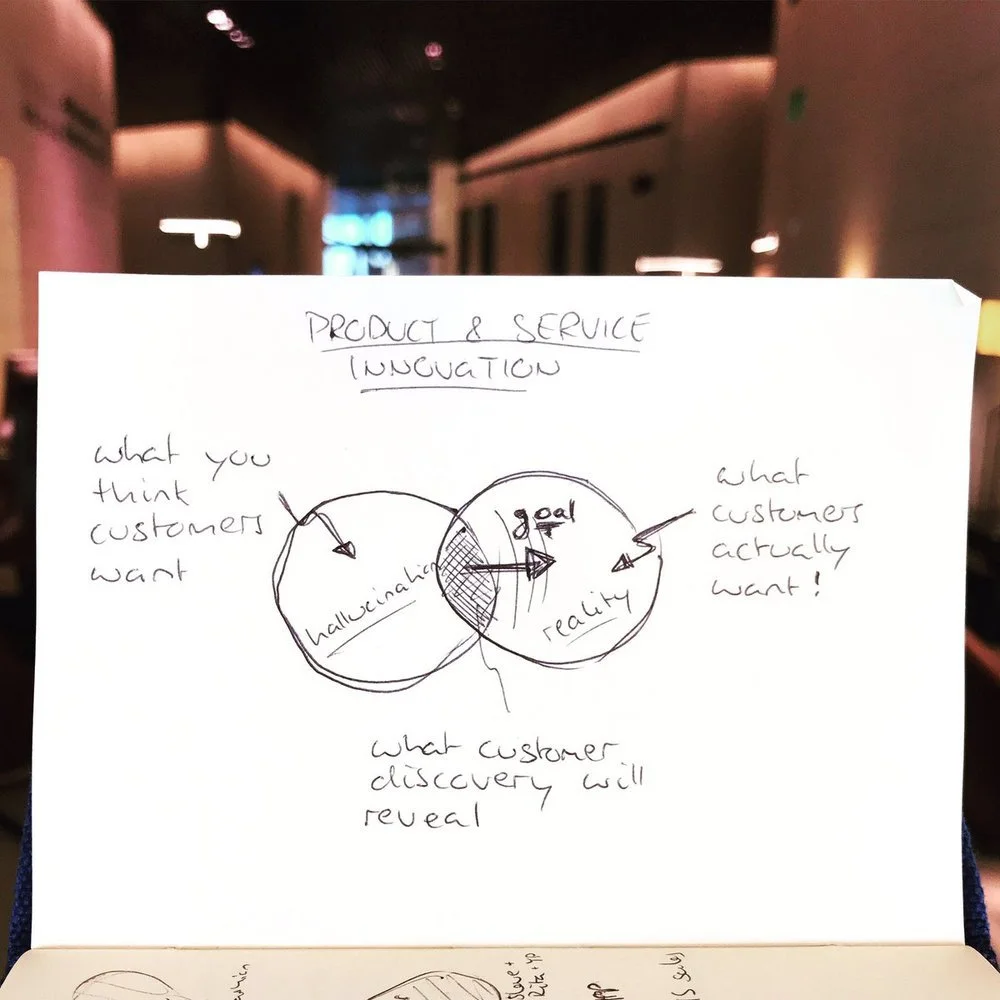
Sometimes, we are so certain that we know what customers want, that we don’t think we need to test our ideas. In fact, the smarter and more experienced we are, the more likely we believe we are right. The more we rely on our opinion, the bigger the risk that we might be hallucinating. It’s only by testing, and Customer Discovery, that we unearth the customer reality.

The more you test and perform Customer Discovery, the more you increase the overlap between your (visionary) ideas and the reality of customer needs. Sometimes when you start out the overlap is bigger; sometimes it’s smaller. However, without testing, you don’t know with certainty.

Make testing a priority

Did you know that you can test many of your business assumptions without even building anything? Entrepreneurs and intrapreneurs often start building early versions of their products and services way too soon. The goal early on is to create the most learning as quickly and efficiently as possible. In this post we explain how to correctly build “Minimum Viable Products” (MVPs) so that you can maximize learning before even building your product or service.

Understand what customers want?

The challenge is, of course, to identify those products, services, and features that matter to customers. Uber, for example, helps people avoid the pain of searching for a cab or wasting time searching for one. Skype eliminated horrendously high fees for international calls.

It’s important to remember that no value proposition can possibly address every problem or desire for your customer. You can, however, prioritize the products, services, and features that will be most valuable to them. This isn’t about asking your customers what features are important to them; it’s about integrating them into the experiment, and getting them to help you decide from the start.

Product box
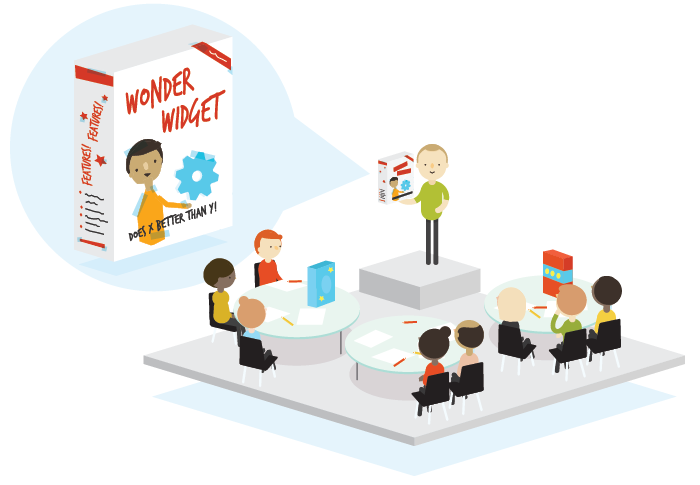
Action: Get your customers to design the package for a “non-existent” value proposition you have described to them.

Outcome: Discover the features that your customers desire by uncovering their jobs, pains, and gains.

  1. Split your customers into groups. Give each group some cardboard and markers and ask them to design a package for the “non-existent” service you have just described.

  2. This will encourage your customers to talk about the slogans, visuals, and features they would want to see on the package for this “imaginary” product.

  3. Your customers must now sell back to you the idea that was originally described through the product boxes they have created. This is where your team must listen carefully and take notes.

  4. Pay attention to what your customers are saying. This isn’t about recording the product they’ve created in their groups, it’s about the underlying jobs, pains, and gains that need to identified through your value proposition. These have to be plotted out in your value proposition canvas.

  5. Some of the feature suggestions might sound impossible ( for example, an implant that can download the news to your brain); but if you pay attention to the underlying desire  in the example I just gave (what are they trying to say?), you might instead notice that your customers just want an effortless way to consume the news everyday.

The buy-a-feature exercise
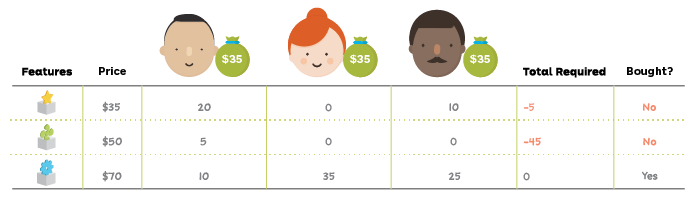
Action: Get your customers to collectively buy the features that interest them.

Outcome: Prioritize the features that customers crave the most.

  1. Take the ideas that your customers suggested during the Product Box exercise and organize them into a feature list.

  2. Price each potential feature according to its estimated development costs.

  3. Give each customer a fixed, hypothetical budget so they can purchase their most desired features. Each individual must not have a budget big enough to buy their own features–instead, they have to collaborate with other members in their group to make a joint purchase.

  4. Observe how the individuals negotiate for the features they want to purchase (why do some want to buy a feature, but others don’t?).

  5. Make note of the features purchased, and point out why your customers were excited about their decisions. These could potentially be the features worth developing.

The two exercises above aren’t meant to produce a final roadmap for feature development. What these exercises really do are provide the cues that can potentially impact your value proposition, and reduce uncertainty around what your customers care about the most.


The Most Common Hallucinations (And How to Spot Them)

Hallucination 1: “Everyone will want this.”

Reality: No product is for everyone. If you think everyone wants it, you have not defined your customer.

Fix: Define your customer narrowly. “Busy working parents in urban areas.” Not “everyone.”

Hallucination 2: “They just do not get it yet.”

Reality: If customers do not get it, you have failed to communicate or you have built something they do not need.

Fix: Assume you are wrong. Ask “what is confusing?” Do not explain harder. Listen better.

Hallucination 3: “The feedback was positive.”

Reality: Most people are polite. They will not tell you your idea is bad. They will say “interesting” and never think about it again.

Fix: Ignore compliments. Seek complaints. Ask “what would have to change for you to buy this?” Pay attention to what they do, not what they say.

Hallucination 4: “We just need more features.”

Reality: Adding features to a product nobody wants creates a product with more features that nobody wants.

Fix: Find one person with one problem and solve it completely. Then expand.

Hallucination 5: “Our competitor is wrong.”

Reality: If a competitor exists, there is demand. Your competitor is not wrong. They are serving customers. Your job is to serve them better.

Fix: Study competitors. Understand why customers choose them. Do not dismiss them.


How to Stay Grounded in Customer Reality

Practice 1: Weekly Customer Conversations

Block one hour every week. Talk to one customer or potential customer. Do not pitch. Do not sell. Just listen.

Questions to ask:

  • “What is the hardest part of your job/day/life right now?”

  • “How are you currently solving that?”

  • “What have you tried that did not work?”

  • “What would make that problem go away?”

Practice 2: The “Five Whys” for Every Assumption

When you assume something about customers, ask “why” five times.

Example:

  • Assumption: “Customers want our premium plan.”

  • Why? “Because it has more features.”

  • Why? “Because more features mean more value.”

  • Why? “Because customers have told us they need those features.”

  • Why? “Because we asked them in a survey.”

  • Why? “Because we have not watched them actually use the product.”

Now you know. You are assuming based on a survey, not behavior. Time to watch.

Practice 3: Build a “Graveyard of Dead Features”

Keep a list of features you thought customers wanted but they ignored. Review it monthly.

Why this helps: It reminds you that you have been wrong before. It builds humility. Humility keeps you grounded in reality.

Practice 4: Invite Criticism

Most entrepreneurs surround themselves with yes-people. Do the opposite.

Ask your team: “What are we pretending not to know?”
Ask your customers: “What is the worst thing about our product?”
Ask your advisors: “Where are we delusional?”

The truth will not kill your business. Ignoring the truth will.


A Real-World Example: The SaaS Founder Who Killed His Hallucination

A SaaS founder named Michael built a project management tool for architects. He had a vision. He spent 18 months building. He launched. Nobody bought.

He was devastated. He had hallucinated.

He stopped building. He called 20 architects who had visited his site but not signed up.

He asked one question: “What would have made you buy?”

The answer crushed him. “We do not need another project management tool. We need a way to share large blueprints with clients without emailing huge files.”

Michael had built the wrong product. He pivoted. He built a simple file-sharing tool for architects. No project management features. Just fast, secure blueprint sharing.

Within six months, he had 500 paying customers.

Michael did not abandon his vision. He abandoned his hallucination. He replaced it with customer reality.


The Difference Between Visionary and Delusional

Visionary Delusional
Has a hypothesis Has a conclusion
Tests assumptions Defends assumptions
Changes based on evidence Ignores evidence
Talks to customers weekly Talks to customers never
Builds small, learns fast Builds big, learns slow
Says “I could be wrong” Says “they just do not get it”
Kills bad ideas quickly Doubles down on bad ideas
Customer reality is the boss Ego is the boss

Be the visionary. Not the delusional.


Frequently Asked Questions (FAQ)

How do I know if I am hallucinating?

Ask yourself: “If I am wrong, how would I know?” If you cannot answer that, you are likely hallucinating.

What if customers do not know what they want?

Customers are experts on their problems. They are not experts on solutions. Listen to their problems. Build solutions. Do not ask them to design for you.

How much validation is enough?

Enough that a stranger gives you money. Pre-orders, deposits, or paid pilots are validation. Compliments are not.

Can vision ever be right when everyone says it is wrong?

Yes. Sometimes vision is ahead of its time. But even then, customer reality will validate it. If no one wants it today, it is not a business today. Timing is part of reality.

What if I have already built something and nobody wants it?

Pivot or kill it. Do not double down. The sunk cost fallacy will destroy you. What you have already spent does not matter. What matters is what you do next.


The Bottom Line

Vision is essential. Without it, you build nothing new. You solve no interesting problems. You change no lives.

But vision without validation is not vision. It is hallucination.

Hallucination feels like vision. It talks like vision. It even works like vision—until you launch. Then reality arrives. And reality is unforgiving.

Customer reality is the only truth that matters. What people actually do. What they actually pay for. What they actually come back to.

Your job is not to defend your vision. Your job is to test it against reality. Relentlessly. Brutally. Honestly.

Talk to customers every week. Watch them use your product. Kill features they ignore. Build what they beg for.

Be flexible. Be humble. Be wrong early and often—so you can be right when it counts.

Vision sees what could be. Hallucination sees what never was. Customer reality pays the bills.

Choose reality. Every time.


Ready to test your vision against customer reality? Share this post with a fellow founder who needs to hear it. And subscribe to our newsletter for more product strategy insights every Tuesday.

Looking for fresh content?

Discover our latest tips and insights and the best design highlights, delivered straight to your inbox.

I agree that all the information I provide may be used and stored by AHD Consulting Solution to send me their newsletter.

Our Superpower turns your Ideas into a Successful Business